
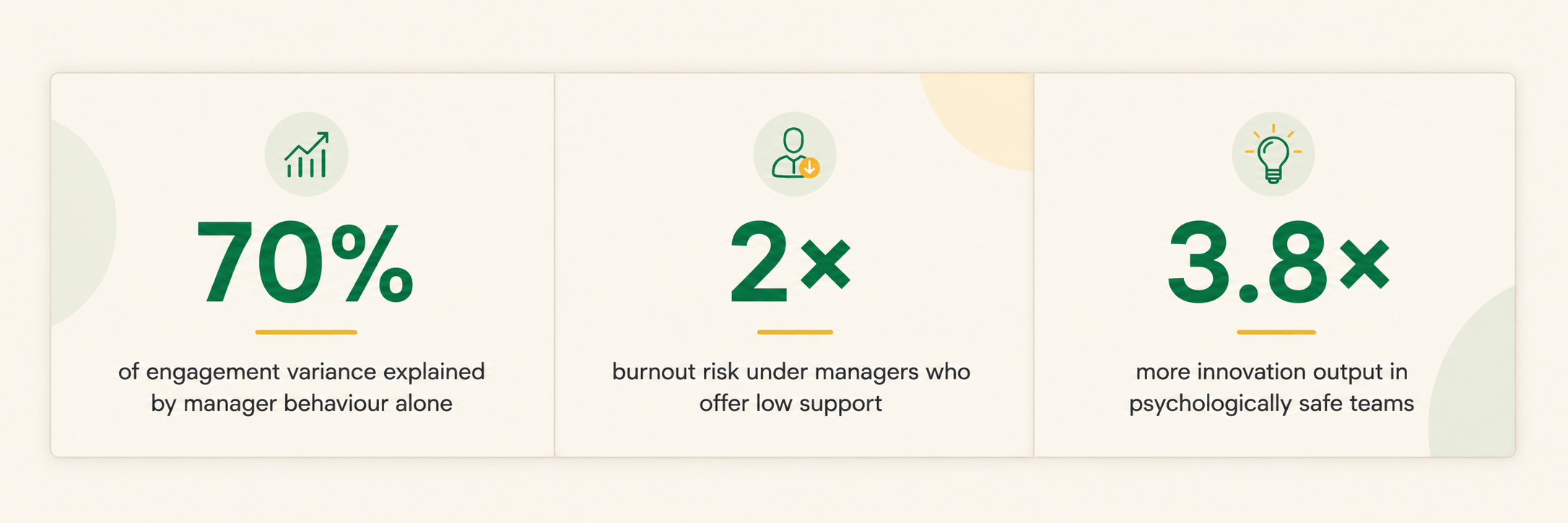
The direct manager relationship is the single most powerful determinant of an employee’s working life, ahead of pay, perks, and corporate mission statements. Decades of data show that employees don’t just leave bad jobs; they leave bad managers, taking their health with them.
The Core Concept: Psychological Safety
Google’s Project Aristotle revealed that high-performing teams require psychological safety: the ability to take interpersonal risks, admit mistakes, and disagree without fear of punishment or humiliation.
“Psychological safety isn’t about being comfortable. It’s about removing the neurological tax that threat and fear place on every thought a person tries to have at work.”
The Neuroscience of Fear at Work
- Brain Response: The brain treats social dismissal exactly like physical danger, triggering a cortisol spike.
- Cognitive Impact: This spike takes the prefrontal cortex offline, shutting down creative thinking, judgment, and collaboration.
- Result: Forcing employees to “push through” chronic stress is biologically incoherent. A threatened nervous system focuses entirely on survival, not creation.
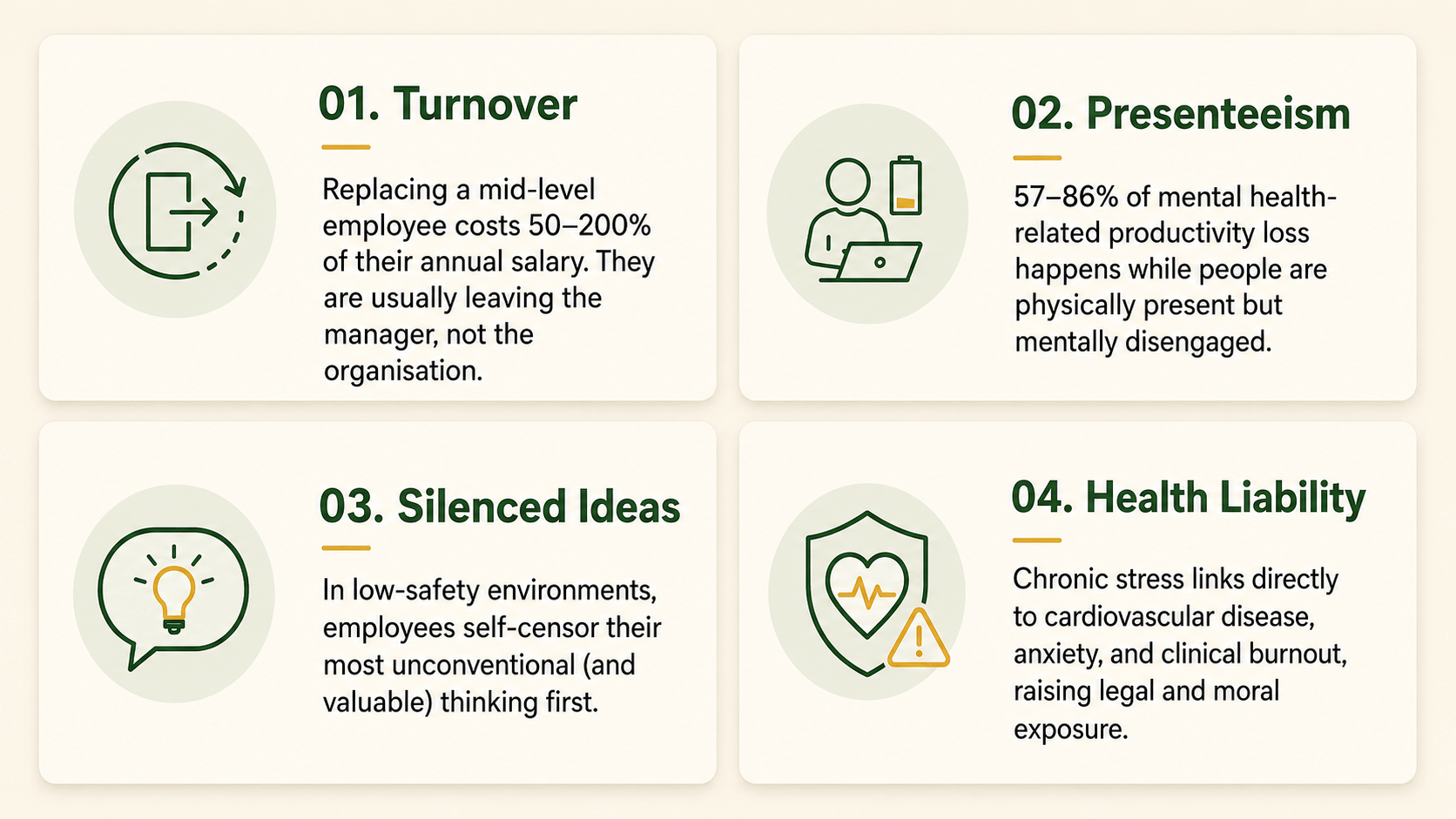
The Concrete Costs of Poor Management
Action Plan: The SAFE Framework
Four core practices from occupational health and organisational psychology that distinguish thriving teams:
- S – Signal Safety: Respond to vulnerability with curiosity. Ask before advising, and model uncertainty to give your team permission to do the same.
- A – Active Presence: Eliminate distractions (phones, Slack) during 1:1s. Full attention is a powerful, underrated intervention.
- F – Feedback as Care: Deliver specific, consistent, and kind feedback. Silence and ambiguity damage well-being far more than honest, direct critique delivered with respect.
- E – Equitable Load: Monitor workload distribution as closely as output. Burnout is a structural failure that targets your highest performers first.
Operational Reality vs. Relational Fabric
- The Root Issue: Traditional workplace wellness apps, EAPs, and awareness emails often fail to move the needle on mental health. True well-being depends entirely on whether an employee feels seen, has clear expectations, and is shielded from chaos by their direct manager.
- The Manager Trap: Managers often carry full individual workloads alongside people leadership, usually without formal training. Investing in manager development yields the highest return of any people initiative.
- Culture Over Systems: Tooling, async workflows, and OKRs only matter at the margins. A highly optimised system built on low trust and fear produces mediocre outcomes. A team with moderate structure and high psychological safety consistently outperforms it.
The Leadership Benchmark: “When did someone on your team last disagree with you and feel completely safe doing it?”
If nothing comes to mind, it is a reflection on the environment, not the team. Environments change fastest when the leader with the most power moves first.