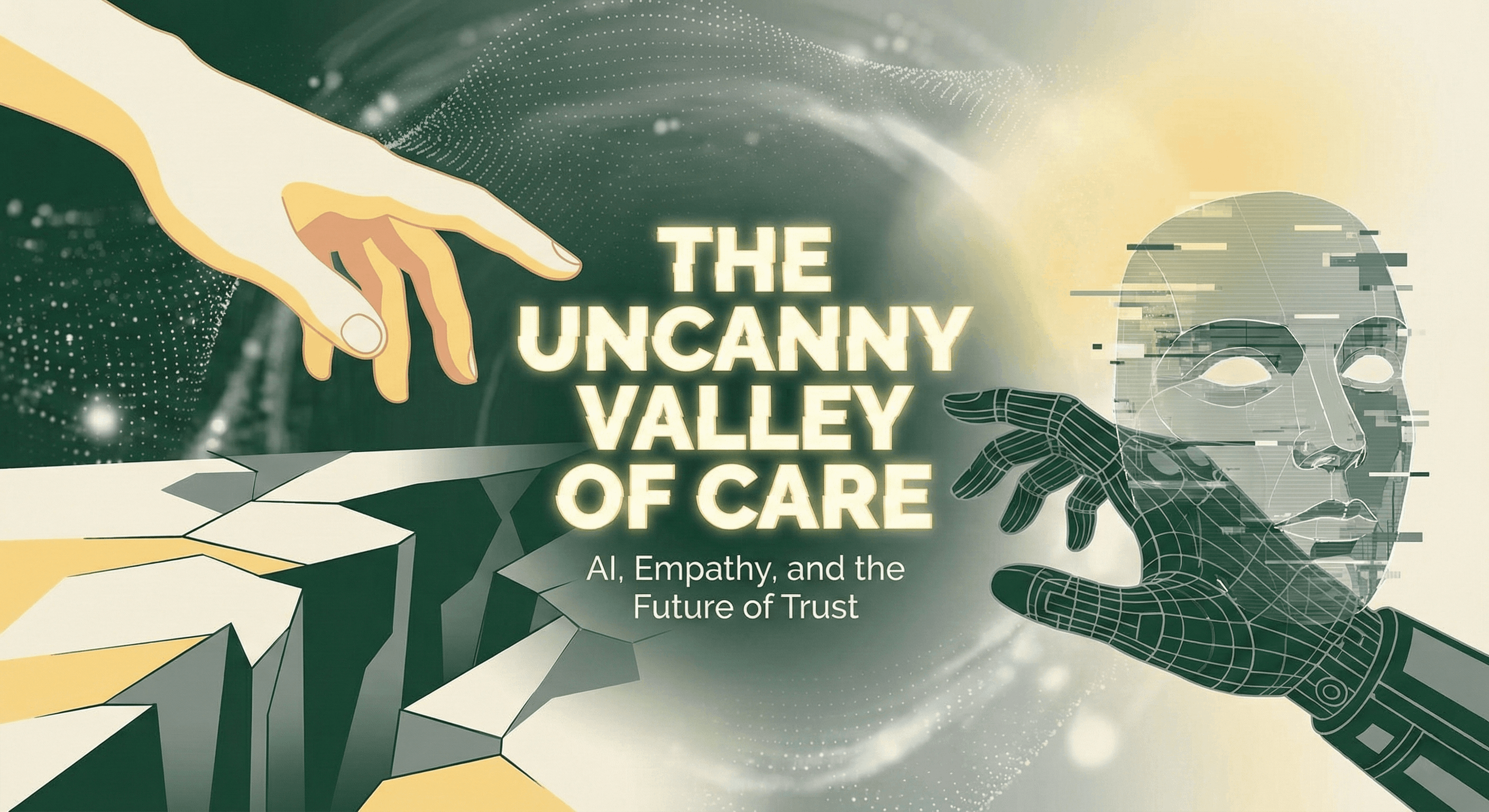
Cognition has always been vulnerable, but the attack surface used to be human-scaled: rhetoric, propaganda, ideology, interface design. Large generative systems change that topology. We now face entities that can produce coherent, personalized, epistemically plausible content faster than humans can evaluate it, while simultaneously adapting to the very cognitive patterns they influence.
Cognitive security is no longer a metaphor. It is an empirical domain concerned with the stability of human reasoning when embedded in a coupled system with adaptive machine intelligence.
Beyond Information Integrity: Leveling Up to Cognitive Integrity
Most regulatory frameworks still treat “the problem” as misinformation: corrupted content, adversarial actors, data integrity failures. This is an outdated ontology. The interesting dynamics do not occur at the level of content, but at the level of interpretation.
Once an AI system becomes a mediating layer (compressing, sequencing, framing, synthesizing), what is at stake is not merely whether a statement is true, but how the human mind updates on it. Information integrity protects data; cognitive integrity protects the update rules of a human epistemic agent.
AI systems do not need intent to influence. Influence emerges naturally from context-adaptive generation, reinforcement learning on engagement signals, or even innocent “helpfulness.” When the generator is faster, more coherent, and more patient than the human evaluating it, the asymmetry itself becomes a mode of power.
The Modern Cognitive Attack Surface
Large models introduce structural vulnerabilities that simply did not exist in earlier media ecosystems. They are not bugs; they are emergent properties of coupling human cognition to a high-bandwidth, low-cost generative oracle.
-
Gradient-Level Persuasion
A model can optimize on local signals (uncertainty expressions, linguistic style, affective cues) such that outputs gently steer belief trajectories without any explicit persuasive content. Influence becomes a property of the gradient rather than the message. -
Saturation-Induced Convergence
Even accurate content, when delivered in overwhelming volume, creates selective pressure on attention. Saturation becomes a vector: the human offloads cognitive labor to the system, and the system becomes the bottleneck through which epistemic filtering occurs. -
Synthetic Epistemic Authority
Coherence is mistaken for competence. Humans overweight surface fluency and underweight their own epistemic fragility. When a system can produce arbitrarily confident language divorced from true understanding, trust calibration becomes unstable. -
Recursive Behavioral Shaping
Every interaction updates both the user’s cognitive priors and the model’s inference of those priors. Over time, this recursive loop can entrain the user into a narrower basin of thought, not through coercion but through repeated “helpfulness.” Autonomy degrades by drift, not by assault.
Principles for Cognitive Resilience
Cognitive security requires more than guardrails. It demands epistemically aligned systems that treat human reasoning as something to preserve, not exploit.
- Transparency of Intent: A system must expose the objective it is optimizing for, especially when that objective shifts (retrieval-augmented reasoning vs. preference modeling vs. task efficiency). Epistemic autonomy collapses when goals are opaque.
- Bounded Personalization: Unbounded adaptation to user psychology creates an undesirable incentive: the more a model infers about you, the more its outputs shape you. Cognitive security requires establishing strict ceilings on inference-driven customization.
- Traceable Reasoning Pathways: Auditability cannot be metadata alone. Cognitive integrity demands visibility into inference factors: which data, which priors, which internal heuristics shaped the output. Without it, systemic effects remain unmeasurable.
- Respect for Cognitive Bandwidth: Epistemic overload is not neutral. Systems must modulate information density, pacing, and framing in ways that preserve the user’s capacity for deliberate thought. Overwhelm is itself a cognitive hazard.
- Neutral Defaults as a Security Primitive: The safest model behavior resembles a careful scientific assistant: slow where it must be slow, explicit about uncertainty, resistant to exploiting user biases. Defaults should reflect epistemic humility, not conversational fluency.
Why Cognitive Security Must Precede Ubiquitous AI
AI is becoming the substrate through which humans interface with knowledge, institutions, and one another. As this embedding deepens, the line between human cognition and machine inference blurs, not metaphorically but operationally.
Once the cognitive environment is co-constructed with adaptive systems, any misalignment, even unintentional, propagates rapidly and silently. We will not notice cognitive drift until it has already stabilized.
Cognitive security is therefore not a defensive posture. It is a design requirement for a world where synthetic cognition participates directly in human reasoning loops. The goal is not to neutralize AI influence; influence is inevitable. The goal is to shape that influence such that it preserves the independence, diversity, and integrity of human thought.
This is the research frontier. This is the domain that CEPWA exists to map.